The Place
Queens Road West
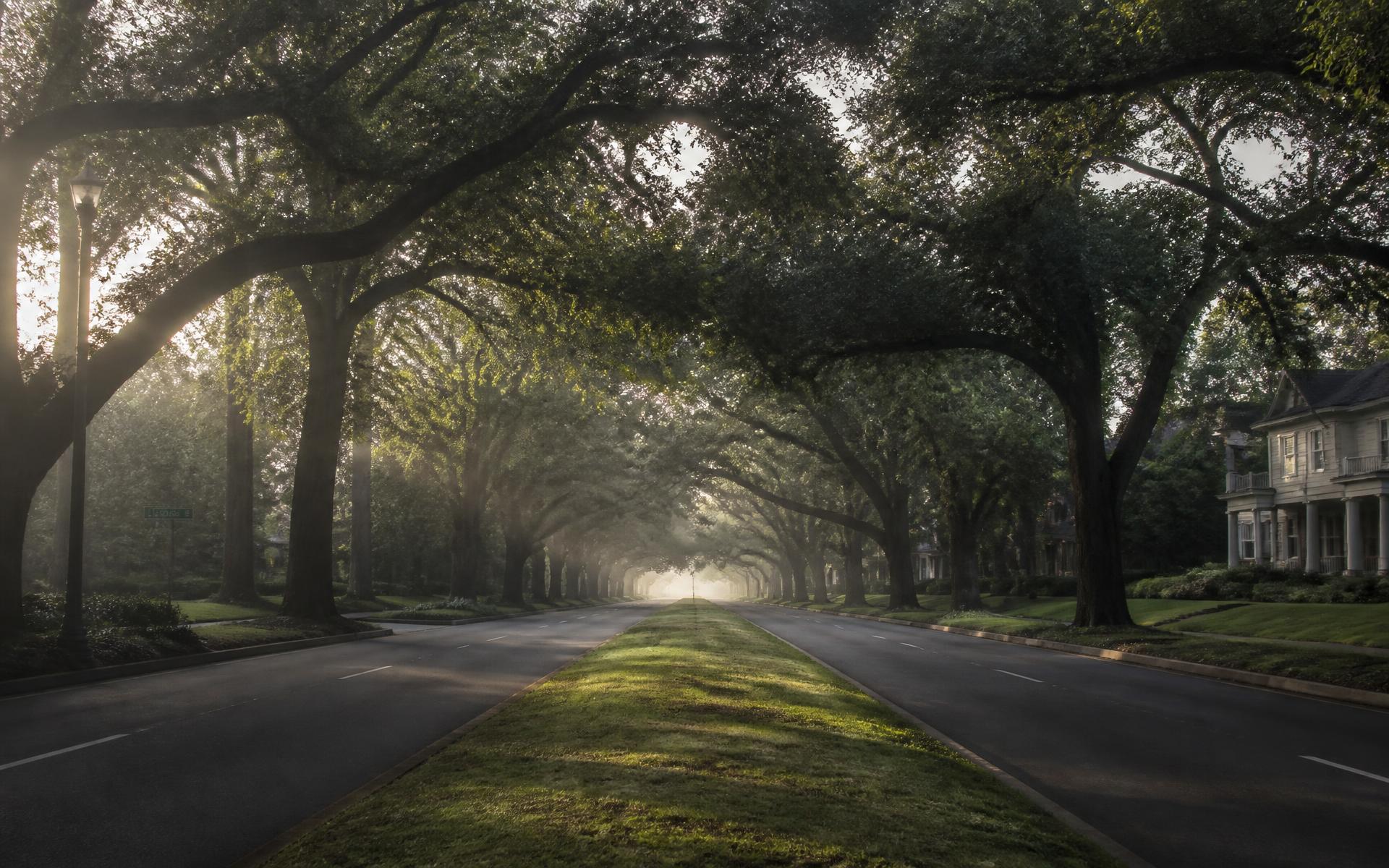
The most photographed street in Charlotte, and the clearest single argument for what John Nolen was trying to do in 1911.
Reviewed · Discover Myers Park editorial desk
The Canopy
There is a specific stretch of Queens Road West where the willow oaks on both sides have grown together overhead and the roadway disappears into green. In October it turns bronze. In April the dogwoods and azaleas underneath it flower at once. People drive across the state to photograph it, and every spring the neighborhood quietly absorbs a few thousand strangers standing in the middle of a residential street.
The effect is not accidental and it is not old-growth forest. It is the product of a planting specification written into a 1911 subdivision plan, executed over the following two decades, and then maintained — through storms, disease, road widening pressure, and construction — by a city arborist's office and a neighborhood that has treated the trees as infrastructure rather than landscaping.
Nobody who bought a lot here in 1913 ever saw this. They planted it for us.
Three Queens Roads
Queens Road, Queens Road West, and Queens Road East are three different streets that intersect one another. This is genuinely confusing, it defeats navigation apps with regularity, and it is a reliable way to identify someone who has just moved here. The short version: Queens Road is the original streetcar spine curving out from Uptown; Queens Road West splits southwest from it through the center of the neighborhood.
What owning here involves
Frontage on Queens Road West carries a premium and a set of obligations. Mature street trees mean protected root zones that constrain driveways, utility trenching, foundation work, and staging during any construction. Visibility means that additions and rebuilds are seen — and commented on — by the whole city. And traffic, particularly during canopy and bloom seasons, is real.
If the canopy is what you want but the exposure is not, the streets immediately adjacent offer much of the same tree cover with a fraction of the attention. Our street-by-street guide covers the alternatives, and The Tree Canopy explains the rules that come with living under old oaks.
Questions
Frequently asked
Queens Road West branches from Queens Road in Myers Park and runs southwest through the heart of the neighborhood. It is distinct from Queens Road and from Queens Road East — a source of persistent confusion for visitors and delivery drivers alike, since all three exist and intersect.
Willow oaks were planted in the wide planted verges on both sides when the street was laid out in the 1910s. Willow oaks branch high and spread wide, so a century of growth on both sides of a relatively narrow roadway produces a continuous overhead canopy — the effect people describe as a cathedral or tunnel.
Street trees in the public right-of-way are city assets and are managed under Charlotte's tree ordinance and urban forestry program; removal generally requires city approval and typically only proceeds for hazard or disease. Trees on private property are also regulated, particularly during construction, through protected root zone requirements.
Predominantly large Georgian Revival, Colonial Revival, Neoclassical, and Tudor houses from the 1915–1940 period on generous frontage, with a smaller number of later and contemporary rebuilds. Because the street is so visible, new construction here draws more scrutiny than almost anywhere else in Charlotte.
Both, with a caveat. It is a genuine residential street with the neighborhood's best walking and its most photographed frontage, but it also carries steady traffic and a constant stream of visitors, wedding photographers, and film crews during peak canopy and bloom seasons. Quieter equivalents exist a block or two away.
Continue reading
- Read →
The Tree Canopy
Why the willow oaks exist, who protects them, and what that means if you own one.
- Read →
Architecture of Myers Park
Georgian Revival, Tudor, Colonial Revival, and the modern houses that earned their place among them.
- Read →
Selwyn Avenue
The neighborhood's working edge, its small commercial node, and what a corridor address means.
- Read →
Interactive Myers Park Map
Streets, parks, schools, clubs, and tables — plotted and filterable.